
The Silver Lining – Trends in Life Sciences in 2026
- Published
- Jan 16, 2026
- Share
After a few slow years, the U.S. life sciences IPO market is anticipated to rebound in 2026. 2025 saw only a small number of successful biotech IPOs. Investors were hesitant because of factors like pharmaceutical price controls, inflation, tariffs, and concerns about interest rates.
However, there were also promising signs late in the year, including a record wave of follow‑on equity financings and a strong biotech stock rally. These signals suggest that IPO activity could pick up in 2026, although conditions will likely remain more selective than they were during the 2020-2021 boom.
Specifically, high-quality companies with strong clinical data and sustainable revenue are most likely to go public successfully in 2026.
2025 Recap: Market Sentiment Swung (Mostly) Upward Late in the Year
The broader life sciences sector enjoyed a significant rebound in market sentiment toward the end of 2025 as the S&P Biotech Index (XBI) rallied with a nearly 36% increase. For context, the biotech sector’s 36% gain far outpaced the S&P 500’s return of 16% in 2025 and the Nasdaq Composite’s return of 20% in 2025. In short, biotech stocks outpaced the broad indices reflecting resurgent investor confidence. In 2025’s slow IPO landscape, private markets financed some robust life sciences companies that are ripe to IPO this year; they kept biotech innovation and clinical trials progressing. Conversely, life science startups unable to attract big private or corporate investment rounds often had to scale back clinical programs and back-office operations, pursue corporate partnerships, or accept early acquisition offers.
2025’s Impact on the 2026 Landscape
This contrast between the “haves- and have-nots” will influence the IPO landscape of 2026 and beyond; there is a cohort of well-funded, clinically advanced life science companies waiting at the doorsteps of Wall Street for the IPO window to reopen. Meanwhile, other IPO candidates may have to turn to alternative strategic equity, debt, and program funding offerings.
2 Biotech Companies Represent Opposite Sides of the 2025 Life Sciences Market Coin
While the IPO market slowed most of the year, the drought was finally broken in September 2025. LB Pharmaceuticals, a New York biotech developing a schizophrenia drug, pulled off an upsized IPO, raising $285 million. LB’s offering, which came on the heels of positive Phase II data for its lead compound, marked a revival of sorts for 2025’s biotech IPO landscape.
Conversely, Odyssey Therapeutics filed for an IPO in January 2025 but withdrew later in the year, deeming it “not in the best interests of the company” to proceed amid poor market conditions. Odyssey chose to stay private given the unfavorable climate and in September 2025, closed a $213 million Series D financing deal instead.
Established, mature public biotech and pharma companies turned to follow-on equity offerings and convertible debt to raise capital in 2025. This financing model far outstripped the capital raised by life sciences companies via IPOs in 2025 and, while 2025 financings trended far below 2024 follow-on offerings, 2025 follow-on financing transactions were well ahead of comparable 2023 and 2022 levels. Notably, December 2025 delivered recent record-setting investments for the life sciences industry, as evidenced by eight biotech companies raising a combined $3.2 billion in follow-on offerings within 24 hours on December 9, 2025, with seven of the eight deals upsized over Wall Street expectations due to overwhelming demand.
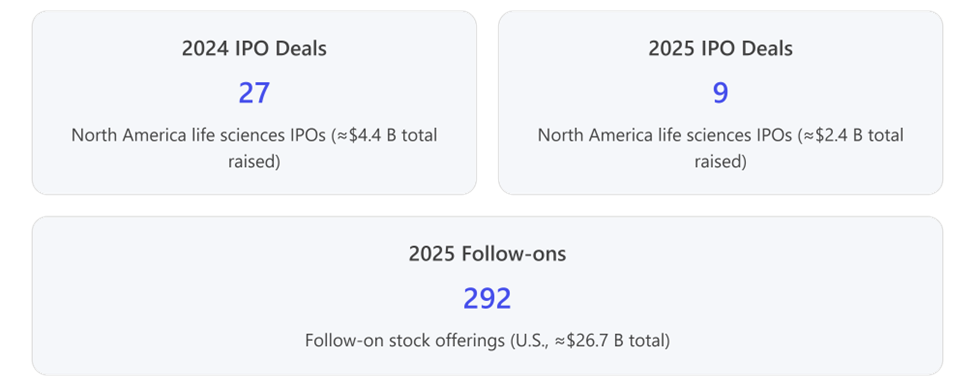
Source: Biotech IPO window shows green shoots, with momentum building for 2026 - ION Analytics
2026 Prediction: A Rebound Year for the Right Life Sciences IPOs
Looking ahead, 2026 is poised to be a rebound year for the life sciences IPO market, though not a return to the frenzied levels of the past life sciences booms. Many companies that postponed going public over the past few years are now targeting 2026 or 2027 for their potential IPOs, assuming market, regulatory, and economic conditions continue to improve.
On the other hand, many private companies that consummated successful venture capital and private equity financings in 2025 may not have the desire to go public. They’d rather avoid the costs, volatility, and public and regulatory scrutiny of going public, especially given their access to available capital in the private markets.
Potential interest rate cuts in 2026 would lower the cost of capital and may prompt investors to seek riskier growth opportunities in the life sciences space again. Still, investors will likely remain selective, eyeing companies with the right profile as the bar for IPO candidates is higher now.
Investors Remain Cautious, Requiring Proof of a Company’s Promise
In contrast to prior years when preclinical life science companies could go public, today’s investors require more tangible achievements, such as Phase 2 or 3 clinical data, multiple product streams, clear regulatory paths, or even early, sustainable revenues. Very early-stage drug developers will remain private longer, relying on venture funding and R&D partnerships until they reach key clinical milestones.
The IPO class of 2026 will likely skew toward more mature, de-risked life sciences businesses as well as deals that are right-sized and reasonably priced to leave sufficient upside for investors.
Most industry analysts expect 2026 to bring a modest revival in life sciences IPO activity, with an increase from 2025’s low levels, potentially returning to a steady pace of offerings by the second half of 2026. Any sustained resurgence will depend on maintaining stability in macroeconomic conditions and on successful clinical and commercialization outcomes from the initial IPO filers.
The Policy Environment's (Largely Positive) Impact on 2026 Markets
The life sciences industry enters a policy environment that is notably more supportive of innovation and capital formation. The current administration’s stance, marked by streamlined FDA regulatory pathways and easing interest rates, has helped restore investor confidence. The introduction of the “One Big Beautiful Bill” tax legislation further bolsters the sector with expanded R&D tax credits, favorable capital gains treatment, and enhanced corporate tax benefits for emerging growth companies.
If the early batch of 2026 IPOs performs well, it could open the door for more life science companies in the pipeline to follow suit. However, if early deals struggle, the recovery of the life science IPO markets could stall.
Ready for an IPO in 2026? Preparation & Optimism Will Go a Long Way Toward Success
For life sciences companies and investors eyeing an IPO, the message going into 2026 is one of preparedness. By approaching 2026 with optimism and thorough preparation, early-stage life sciences firms can position themselves to seize the opportunities of a reawakening IPO market.
Many are likely to test the waters in the first half of 2026. If the initial offerings meet receptive investors and market conditions, we could see a return to a healthy, steady IPO market by mid-year.
The road to the public markets is challenging and fraught with impediments. Yet, it could be reopening for those life science companies ready and able to navigate their challenges with solid clinical data and a sound financial and commercial strategy.
What's on Your Mind?

Eli Silverman
Eli Silverman is a Senior Audit Manager in firm’s Technology Group with over 10 years of experience
Start a conversation with Eli


