
Business Continuity
Operational Resilience Starts with the Right Questions.
Operational disruptions — whether from system outages, supply chain failures, or unexpected events — don’t wait for organizations to be ready. For executives responsible for organizational resilience, the question is not whether a disruption will occur, but whether your people, processes, and technology are positioned to keep the business running when it does.
EisnerAmper’s Business Continuity Services help organizations move from exposure to preparedness. With deep industry knowledge, we work alongside your leadership team to assess critical business functions, understand the true impact of potential disruptions, and build actionable continuity plans that hold up under real-world pressures.
Our Services
A Complete Business Continuity Program - From Assessment to Action
We deliver end-to-end business continuity support, structured around the capabilities that matter most to your organization.
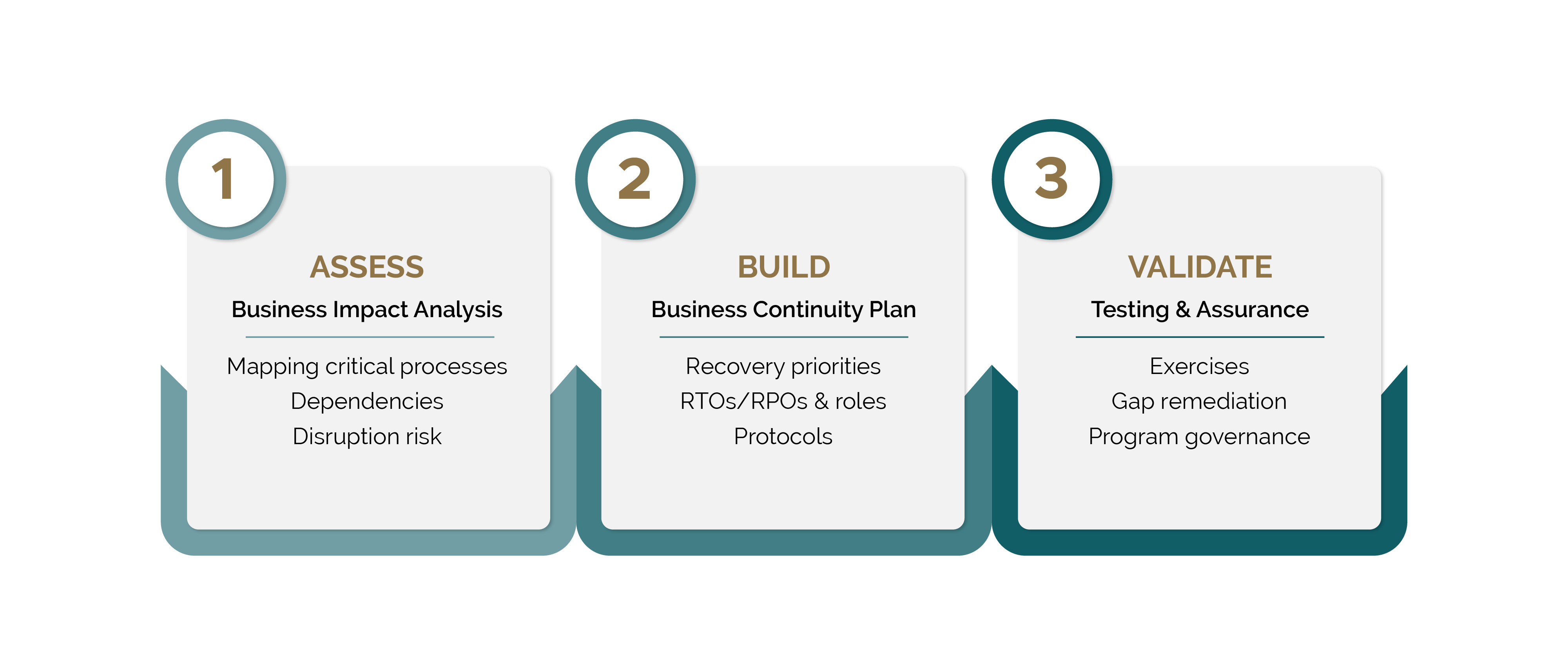

Business Impact Analysis (BIA)

Business Continuity Plan Development
Disaster Recovery Alignment
Testing & Exercises
Program Review & Assurance
Our Approach
Built for Your Business — A Tailored Approach for Every Organization
Effective business continuity planning is not a one-size-fits-all exercise. We begin every engagement by getting inside your organization — understanding which functions drive revenue, where operational dependencies create vulnerability, and what a disruption would actually cost. This is especially critical for organizations operating in highly regulated environments, where regulatory requirements, system interdependencies, and operational complexity raise the stakes of every continuity decision.
We pair a structured methodology with deep experience to know which questions to ask in complex, high-stakes environments. Our deliverables are designed to be actionable: clear enough for your leadership team to own, specific enough for your operations team to execute, and credible enough to satisfy regulatory and board-level scrutiny.
Why EisnerAmper
Your Business Continuity Partner — From Analysis to Action
Your advisor matters as much as your plan. We bring technical depth, industry experience, and a hands-on approach to build a continuity program that’s credible, actionable, and built to last.
We Know the Right Questions to Ask
Integrated Risk Advisory Capabilities
Cross-Functional, Multi-Industry Experience
Actionable Deliverables, Not Binder-Ware

Frequently Asked Questions
What is business continuity planning?
Business continuity planning (BCP) is the process of identifying and documenting the procedures, resources, and responsibilities an organization needs to continue operating during and after a disruptive event. An effective BCP addresses people, processes, technology, and third-party dependencies — and is built on the findings of a business impact analysis that prioritizes recovery based on operational and financial consequences.
What is a business impact analysis, and why does it come first?
A business impact analysis (BIA) is the foundation of any effective continuity program. It identifies the critical processes and functions within your organization, across technology, other teams, and third parties, and quantifies the cost of a disruption to each. The BIA determines recovery priorities, informs recovery time and point objectives, and provides the factual basis for every decision made during the BCP development process.
What is the difference between business continuity and disaster recovery?
Business continuity is a broader discipline focused on keeping critical operations running across people, processes, and systems during any type of disruption. Disaster recovery (DR) is a subset of continuity planning focused specifically on restoring IT systems and data after a failure. A complete resilience program includes both.
What should a business continuity plan include?
A well-structured BCP typically includes: a completed business impact analysis, defined recovery time objectives (RTOs) and recovery point objectives (RPOs) for critical functions, clear roles and responsibilities for the recovery team, communication protocols for employees, clients, and vendors, documented recovery procedures for each critical process area, and a testing and maintenance schedule to keep the plan current.
Who is responsible for business continuity planning in an organization?
Business continuity is ultimately an executive responsibility – typically owned at the COO, CIO, or CCO level – but effective programs require cross-functional participation. HR, IT, finance, operations, legal, and compliance all play roles in BIA facilitations, plan development, and testing. A common engagement model is to bring in an external advisory team to facilitate the BIA and the planning process.
What's on Your Mind?


Start a conversation with the team