
SEC Rulemaking Proposals Could Reshape Public Company Reporting: What Audit Committees Need to Know
- Published
- Aug 10, 2026
- Share
In May 2026, the SEC issued a series of interconnected proposals that could significantly alter how public companies report. While the proposals are not yet final, they collectively signal a policy objective to reduce regulatory burdens, expand access to capital markets, and provide greater flexibility for public companies.
For audit committees, however, these proposals are not simply about reducing compliance requirements. Rather, they introduce new governance decisions regarding reporting cadence, investor communications, capital markets readiness, and oversight of internal controls. As several of the proposals would create optionality rather than mandate change, audit committee judgment may become increasingly important.
This article provides an overview of the three major SEC proposals and highlights key considerations audit committees should begin evaluating now.
Key Takeaways
- The SEC’s proposals would give public companies more flexibility in reporting, capital access, and filer status, but they would also require more deliberate governance decisions.
- Audit committees should evaluate whether less frequent SEC reporting would align with investor, analyst, lender, and other stakeholder expectations.
- Expanded access to registered offerings may increase the need for strong reporting readiness, disclosure controls, and auditor coordination.
- Potential filer status changes may reduce certain compliance requirements, but audit committees should continue prioritizing ICFR rigor and oversight accountability.
Proposal 1: Optional Semiannual Reporting
The SEC has proposed allowing public companies to elect semi-annual reporting through a new Form 10-S in lieu of filing three quarterly Forms 10-Q. Under the proposal, quarterly reporting would remain the default framework unless a company affirmatively elects semiannual reporting as part of its annual Form 10-K filing. The Form 10-S would include reviewed interim financial statements and substantially the same categories of information currently required under Form 10-Q, adapted for a six-month reporting period.
Importantly, the proposal would not eliminate other ongoing reporting obligations. Form 8-K reporting requirements would remain unchanged, and companies could continue issuing quarterly earnings releases if they choose to do so.
Key Audit Committee Considerations
Although the proposal may appear to reduce reporting burdens, some companies may find that investor expectations continue to drive quarterly communications. Audit committees should carefully assess whether investors, analysts, lenders, and other stakeholders would view less frequent SEC reporting favorably, and many companies are still evaluating how investors and analysts may react to a reduction in quarterly reporting.
Additional governance questions include:
- Would the company continue issuing first- and third-quarter earnings releases?
- If quarterly earnings are released, what level of auditor involvement would be expected?
- Would disclosure controls and procedures (DCP) and internal control over financial reporting (ICFR) monitoring continue on a quarterly cadence?
- Could financing agreements, debt covenants, or other contractual arrangements still require quarterly financial information?
For many issuers, the decision may be less about reducing costs and more about determining whether a different reporting cadence aligns with investor expectations and governance objectives. As a result, audit committees should evaluate the proposal through a strategic lens rather than solely as a compliance and cost reduction exercise.
Proposal 2: Registered Offering Reform
The second proposal seeks to modernize the registered offering process and facilitate more efficient access to public capital markets. Among other changes, the proposal would:
- Broaden Form S-3 eligibility and shelf registration access.
- Extend offering communication flexibilities currently available primarily to larger issuers.
- Expand research coverage opportunities.
- Streamline Form S-1 reporting through greater incorporation by reference.
- Preempt state registration requirements for registered offerings.
Collectively, these changes are intended to reduce friction in the registered offering process and promote capital formation.
Key Audit Committee Considerations
While easier capital access may benefit issuers, it may also increase expectations around reporting readiness.
If companies gain the ability to access capital markets more quickly, management and audit committees will need confidence that financial reporting processes can keep pace. Financial statements must remain current, disclosure controls must be effective, and auditors may need to be involved on accelerated timelines.
Audit committees may wish to consider:
- Whether management's capital markets readiness plans remain appropriate.
- Whether disclosure controls can support more frequent or accelerated transactions.
- Whether shelf registration strategies should be revisited.
- Whether auditor coordination and comfort letter planning processes are sufficient to support faster offering timelines.
In many cases, these reforms could make access to registered markets easier. However, moving quickly requires equally prepared governance, reporting, and financial statement processes.
Proposal 3: Filer Status Reform
The third proposal would substantially simplify the SEC's filer status framework.
Under the proposal, the SEC would largely move to two primary filer categories:
- Large Accelerated Filers (LAFs)
- Non-Accelerated Filers (NAFs)
The proposal would increase the threshold for Large Accelerated Filer status from $700 million to $2 billion of public float and introduce additional seasoning requirements before companies qualify as LAFs. Companies that do not meet those criteria would generally become Non-Accelerated Filers and gain access to a broader range of scaled disclosure accommodations.
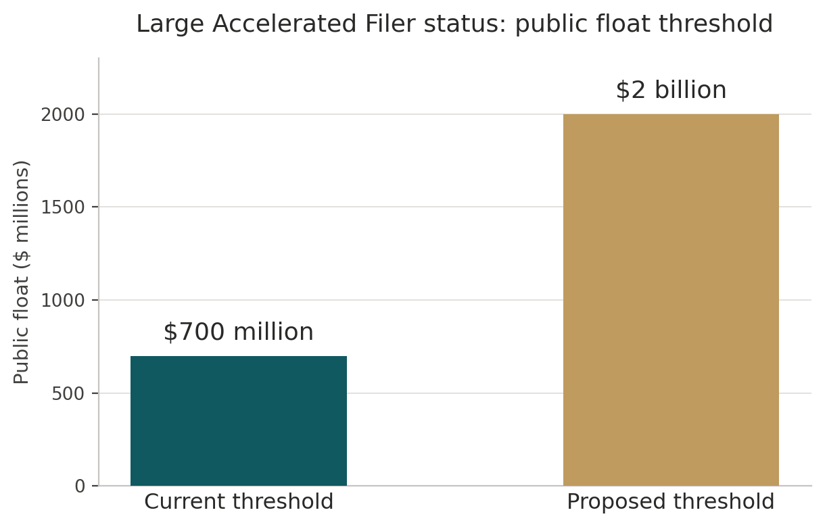
Figure: Large Accelerated Filer public float threshold, current vs. proposed.
Perhaps most notably, Non-Accelerated Filers would no longer be subject to the auditor attestation requirements of Section 404(b) of the Sarbanes-Oxley Act. Management's responsibility for evaluating and reporting on ICFR would remain unchanged.
Key Audit Committee Considerations
The prospect of relief from auditor attestation requirements may be attractive for many issuers. However, audit committees should recognize that reduced compliance requirements do not equate to reduced responsibility.
Questions audit committees should consider include:
- How would the company be classified under the proposed thresholds?
- Would management continue to maintain the same rigor over ICFR absent an auditor attestation?
- Does reduced external assurance alter the committee's assessment of financial reporting risks?
- Would internal governance structures or monitoring activities need to change?
The proposal effectively shifts greater responsibility onto governance structures and management accountability. As a result, audit committees should avoid viewing 404(b) relief as a substitute for strong internal control environments.
A Common Theme: Greater Flexibility Requires Greater Governance
Although the three proposals address different areas of SEC regulation, they share a common objective: reducing barriers to capital formation and public company reporting. The proposals would provide companies with more flexibility regarding how they report, how they access markets, and how they comply with SEC requirements.
For audit committees, however, greater flexibility creates additional governance choices.
Reporting cadence decisions may become elective. Capital raising opportunities may accelerate. Filer status classifications may change. Some companies may find themselves operating with fewer mandated compliance requirements but increased expectations from investors and boards regarding oversight and accountability.
Accordingly, audit committees should begin evaluating the potential implications now, including:
- Reporting cadence and investor communication strategies.
- Disclosure controls and ICFR monitoring.
- Auditor involvement and comfort letter considerations.
- Capital markets readiness.
- Potential filer status outcomes under the proposed framework.
Looking Ahead
The public comment period for these proposed amendments ends July 27, 2026. The SEC will then review such comments, and final requirements may differ from the current proposals. Nevertheless, public companies and audit committees would be well served to begin modeling potential impacts now. The companies best positioned for success will be those that view these proposals not simply as regulatory changes, but as governance decisions that affect how they communicate with investors, oversee financial reporting, and access capital.
EisnerAmper's National Office continues to monitor SEC rulemaking developments and their implications for public companies, audit committees, and financial reporting governance. To better understand how these proposed SEC rule changes may affect reporting requirements, governance practices, and capital markets readiness, contact our team using the form below.
What's on Your Mind?


Start a conversation with the team


