
Tokenomics: Use AI Efficiently for Less
- Published
- Sep 1, 2026
- Topics
- Share
A first look at how a more intentional approach to AI use can cut costs — and what your organization can put into practice this week
AI adoption across organizations has moved quickly, and for good reason: As these tools improve, the time savings are real. However, that speed has come at a cost most organizations haven't measured. Why? Because most teams have no idea what a single prompt costs, or whether the task at hand justifies that cost.
Tokenomics, the practice of using AI's computational resources intentionally and economically, closes this gap.
Key Takeaways
- Practice tokenomics: Use AI’s computational resources intentionally and economically by weighing the value, quality, and cost of each task before prompting.
- Use plan mode for complex work: Review and correct the approach before execution to reduce unnecessary prompts, rework, and token use.
- Match the model to the task: Start with the least costly model delivering the required quality, and reserve top-tier models for complex, high-stakes work.
- Measure efficiency beyond speed: Consider output quality, financial cost, computing resources, and environmental impact.
- Make AI use visible and reusable: Share usage data, set informed budgets, and reuse effective prompts and outputs instead of rebuilding solutions.
The Mindset Shift: Pause Before You Prompt
As AI becomes part of the daily workflow, it's tempting to slip into a “try first, consider later” habit, but every prompt consumes real computing resources. Tokenomics starts with weighing the cost before you run the prompt, not after.
Before starting a task with AI, ask yourself the following two questions.
Do I Truly Need AI for This Task?
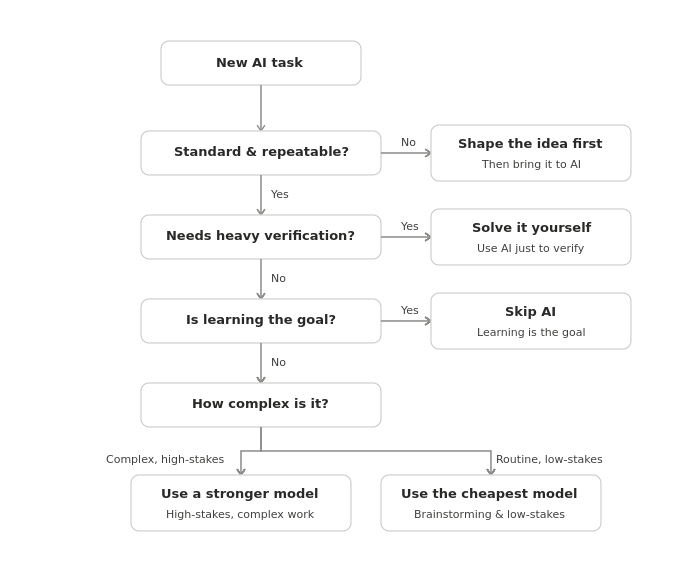
Standard, repeatable tasks with outputs requiring little verification are ideal for AI. High-stakes brainstorming or creative work is different. Flesh out your own idea first; then, bring a concrete draft to your AI chat. For complex and multi-part tasks, separate the sub-tasks AI can own from the ones you should keep for yourself.
The Power of Plan Mode to Conserve Funds and Frustration
Plan mode improves token and task efficiency by separating thinking from doing. Instead of letting an LLM immediately start editing files or executing steps, it first produces a proposed plan you can review, correct, and approve before any work begins. This front-loads course correction to the cheapest possible point.
Revising a few sentences of a plan costs far fewer tokens than undoing wrong edits, regenerating files, or walking back a chain of misguided steps. It also reduces wasted exploration, since the model commits to a scoped approach rather than wandering through trial and error. Also, it catches misunderstandings about requirements early, avoiding entire cycles of "That's not what I meant" rework.
The result is fewer total turns, less redundant context accumulating in the conversation, and a higher likelihood that the execution phase succeeds on the first attempt, so both the token budget and your time are spent on doing the right work once instead of doing the wrong work twice.
A simple prompt addendum of “Show me your plan; do not execute any work until I give explicit plan approval” enables this process.
Which Model Actually Fits This Task?
Not every task needs the same horsepower. Ask whether the job calls for a complex, high-capacity model or whether a lighter one will suffice. Think of it like healthcare triage; you wouldn't send a surgeon to apply a Band-Aid on a paper cut, and you wouldn't go to the ER for a sore throat when urgent care would do.
Model selection works the same way. Match the model to the task instead of always reaching for the most powerful option. For brainstorming, summarizing, and other low-stakes work, default to the least costly model to accomplish the task at hand. It's usually faster, too. To see how different models actually compare on cost and quality, check out the "Comparison of AI Models across Intelligence, Performance, and Price" section of this article.
Model selection can be combined with the plan mode. A stronger, more intelligent model could be used to develop the plan, with actual execution performed by a lighter-weight, faster model.
The decision tree below makes this concrete.
Redefining What "Efficient" Means in the Age of AI
Often, efficiency is defined solely by how much work can be accomplished in the shortest amount of time. However, speed of delivery does not account for waste, nor does it ensure the right tool is being used for the job.
As an example, a top-end racecar may be the fastest vehicle on the road, but that does not make it the best method of transportation for a family of five driving to the supermarket. Furthermore, if you are using a racecar for everyday driving, your gas and insurance bills will increase exponentially compared to those for a more practical car.
A similar methodology can be used when considering the implementation of an AI model. Consistently using the most complex model available does not always mean it is the correct model to use, nor does processing power guarantee a better result.
Tokenomics measures efficiency differently by balancing throughput with the economy. You still want more work done in less time, but you also weigh the financial, computational, and environmental costs each prompt draws on.
Treat AI like a utility in your home. It runs on energy, and someone pays for it. Your organization covers your AI licenses and consumption the same way you cover your electric bill. Just like your electricity use, there are indirect costs to infrastructure and the environment behind every prompt. Being frugal with AI, the way you’re frugal at home, is how you become a more tokenomical consumer — raising efficiency without creating waste.
The Hidden-Cost Problem
Cost-consciousness is hard when the cost of a prompt is invisible to the person running it. Billing on most platforms is opaque by design, making it nearly impossible to link AI use to its actual cost.
For a broader perspective on measuring AI outcomes, managing organization-wide costs, and applying AI FinOps principles, read AI Economics: Measuring Value, Managing Cost, and Proving Impact.
Here's how to close the gap without needing any major investments:
- Usage dashboards: Most enterprise plans already include usage analytics. Share those dashboards across teams, not just at the administrative level, and people have what they need to make intentional choices.
- Request-level tagging: If your organization builds with APIs, attaching a label to every call and logging token usage centrally enables visibility into spending concentration and reasoning.
- Thoughtful budgeting: Once usage is visible, set computing budgets proactively instead of reactively, grounded in real tokenomics data instead of guesswork.
Share Solutions Instead of Rebuilding Them
Redundancy is one of the most avoidable sources of waste.
When someone on your team has already built a solution, share the output. A colleague facing the same or a similar task can use it as a foundation for iteration, resulting in better products, more collaboration, shorter lead times, and lower expenses.
Keeping communication and documentation open across teams costs nothing and saves real money. In fact, most consumer and enterprise AI tools already natively support sharing projects and prompts.
Putting Model Selection to the Test
To measure the real impact of model selection, we ran identical prompts across Anthropic's Claude model tiers with varying task difficulty, scored each output for correctness and quality, and tracked cost. Prompts ranged from dashboard mockups to full website recreations. Here's what we found:
| Model Tier | Cost Per Task | Typical Quality | What We Saw |
|---|---|---|---|
| Fable 5 (High) | $3.27 | 8/10 | Fable produced the best outcome and design; however, the costs were the highest, often 2-3x that of the next option—likely the best option for planning, but not execution. |
| Opus 4.8 | $0.69 – $1.52 | 7 – 10/10 | Consistently strong but very expensive and rarely the clear top performer. |
| Sonnet (4.6 / 5) | $0.20 – $0.94 | 8 – 10/10 | Matched or beat Opus quality in most tests at 30% to 70% less cost, especially with Extended Thinking enabled. |
| Haiku (4.5 / 4.6) | $0.04 – $0.28 | 4 – 8/10 | The cheapest option by a wide margin, but quality swung the most depending on whether Extended Thinking was enabled. |
Notes on methodology: chat history was disabled across all tests; cost per prompt was pulled from the Usage section of each plan's settings.
Sonnet with Extended Thinking enabled matched or beat Opus's quality in most tests, at 30% to 70% lower cost. Extended Thinking was often the deciding factor for output quality — especially for a lighter-tier model like Haiku.
Across nearly every experiment, the most expensive model rarely won on quality and almost always lost on cost. Next time you're about to prompt, test whether a lower-cost model with Extended Thinking enabled gets you the same result.
For a closer look at model comparison and selection, see Comparison of AI Models across Intelligence, Performance, and Price.
Where to Start with Tokenomics This Week
Intentional use of AI doesn't require a rollout plan or new infrastructure. Commitment to a few small habits, applied consistently, is the best way to begin. Here's where tokenomics starts paying off immediately:
- Build the pause-and-ask habit. Use the two questions above as your checklist before every prompt.
- Use plan mode for tasks, ensuring the execution of the LLM is going to do what you intend.
- Default to a lower-cost model with Extended Thinking enabled. Reserve top-tier models for your most complex, highest-stakes work.
- Share your enterprise usage dashboard with teams, not just administrators.
- Encourage teams to share AI output artifacts instead of rebuilding solutions from scratch.
- Redefine efficiency on your team so speed isn't the only thing being optimized.
Tokenomics isn't a cost-cutting exercise. It's a better way to work. Organizations adopting it now will spend less, move faster, and waste fewer computational resources.
In a future article, we will explore deeper options for organizations ready to go further, including using local LLMs and the agent orchestrator pattern to provide even more value with AI. Subscribe to stay in the loop.
What's on Your Mind?


Start a conversation with the team


